
Introduction: Why escaping is more than driving fast
A police chase can look simple at first: put your foot down, dodge traffic and hope the patrol cars fall behind. But the gameplay shown in the source material suggests a richer challenge. Police investigate incidents, coordinate searches, block routes and can bring in support from the air or water. Meanwhile, your vehicle can take damage, lose a tyre or become difficult to control.
That means a good GTA 6 escape is less about having the fastest car and more about making sensible decisions as the situation changes. In the demonstration, an explosion drew a response, a large truck became awkward to handle, and a parking garage offered temporary cover before officers searched it. Each move created a new opportunity—and a new risk.
I’ll focus on the practical lessons those moments suggest: how to manage visibility, choose a route, use cover and avoid turning a difficult chase into a dead end. These are observations from the described gameplay, not a guarantee that every encounter will play out in exactly the same way.
How attention builds after a crime
A wanted system works through a chain of reactions. Someone may witness an incident, flee from it or report it. Officers can then investigate the scene before they know exactly where the suspect has gone. Later actions may reveal the player’s position and turn a search into a direct pursuit.
The difference matters. In the gameplay, police initially focused on the explosion site while the player attempted to leave in another vehicle. Once more attention was drawn to the player, officers pursued them directly. So, when police arrive, I would not assume that every unit instantly knows my exact location. I would treat the scene of the crime and my current position as separate risks.
The scale and visibility of an event can also affect the response. A collision may attract less immediate attention than a major explosion, while entering a restricted facility can prompt warnings even before a larger offence occurs. A visible weapon or distinctive vehicle may also make a player easier to recognise, though the demonstration does not confirm precisely how every detail affects detection.
Practical tip: After a major incident, avoid lingering to watch the response. Use that time to create distance and consider what witnesses or officers might have seen.
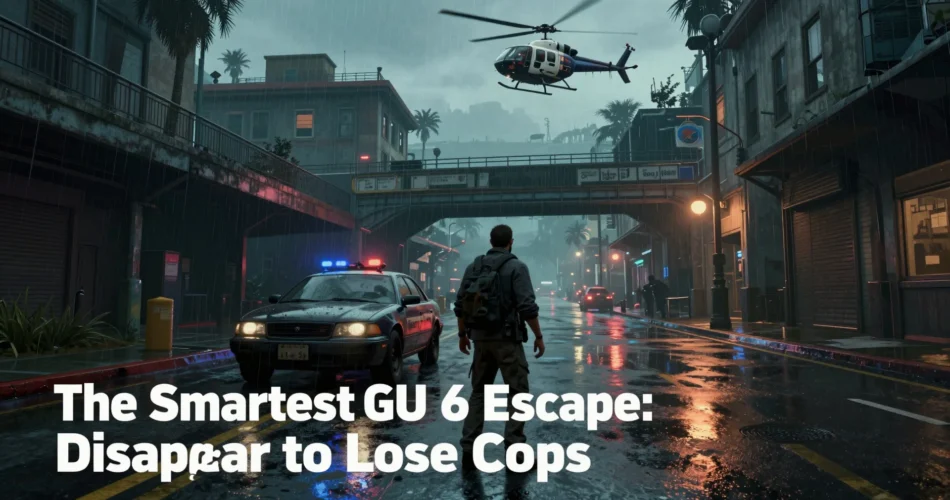
The Smartest GTA 6 Escape: Disappear to Lose Cops
The key idea is to break the chain connecting the player to the last known location. In practice, I would think in stages rather than simply accelerate until the road runs out.
- Break the immediate sightline. Turn away from open roads and use buildings, bends, bridges or dense terrain to interrupt direct observation.
- Avoid predictable routes. A main road may be quick, but it can also lead straight into a roadblock. Look for a side street or a different route through the area.
- Change the problem, not just the speed. If a vehicle is damaged or surrounded, continuing to drive it may be worse than leaving it and moving on foot.
- Keep an exit in mind. Before entering a garage, alley or interior, ask how you will get out if officers arrive.
- Reassess after each move. A quiet moment may mean you have broken contact, not that the search has ended.
In the demonstration, the player escaped a truck, tried wooded terrain and water, then reached the city and entered a parking structure. Each change of environment helped disrupt the pursuit, but none guaranteed safety. The garage, for instance, concealed the player briefly before police searched inside.
That is the useful lesson: hiding is not a magic switch. It is one part of a wider plan involving movement, cover and timing.
Choosing a vehicle that suits the moment
A vehicle is not automatically useful just because it is fast. During a prolonged chase, handling, durability, visibility and access can matter just as much. The source gameplay showed a large truck pushing through obstacles, but it was slow and difficult to manoeuvre. Later, a damaged car with a blown tyre became increasingly hard to control.
| Vehicle choice | Potential advantage | Main drawback |
|---|---|---|
| Fast car | Quick on clear roads | Can be vulnerable to damage and difficult to control when hit |
| Large truck | Mass and ability to push through some obstacles | Slow, conspicuous and awkward around tight turns |
| Boat | Opens a route across water | May be slow, exposed and followed by police boats |
| Parked car | Offers a fresh start | Breaking in can create noise or trigger an alarm |
I would also pay attention to the cost of getting into a vehicle. The gameplay included alarms during attempts to enter parked cars. A car that looks like a perfect escape option may draw attention before it even moves.
My rule of thumb: Choose a vehicle for the route ahead, not just the one nearest to you. A nimble car may work well in tight streets; a boat only makes sense if there is a clear way back to land.
Using land, water and buildings as cover
Different environments change what police can do. On roads, patrol cars can follow, flank or block routes. In open countryside, a helicopter may have a clearer view. Water can separate the player from road units, but it may bring boats and aerial surveillance into play.
The gameplay showed this shift clearly: the player left a truck, moved through rough terrain and then entered the water. Swimming disrupted the road chase, but created other dangers, including a shark. Taking a boat restored movement, yet the chosen vessel was slow and conspicuous. A new route can buy time without being a safe route.
Buildings offer another trade-off. A parking structure or large interior can break a helicopter’s view and provide alternative paths through levels and exits. However, officers may search those areas, as happened in the demonstration. Going inside is therefore a tactical pause, not a guarantee of escape.
I would look for places that offer more than one way out. A garage with a single obvious ramp can become a trap if police block the exit. A building connected to several streets may provide better options—but only if I can move through it without being cornered.
Practical tip: Before switching terrain, consider both the benefit and the next threat. Water may slow ground units, while a city interior may block aerial observation but allow officers to search on foot.
Breaking line of sight versus escaping a search
There is a difference between getting out of view and getting away from the search. When police are actively pursuing you, they may be following or intercepting you. If they lose sight of you, they may still search around your last known location or rely on a description.
That is why I would use a lull to make a considered next move, rather than immediately assuming the chase is over. In the gameplay, the player heard fewer sirens and seemed to have broken direct pursuit, but still believed police had a description. They considered changing clothes and dropping a visible weapon. Dropping the weapon was shown; a clothing change was not.
These actions address different clues. Moving behind a building can interrupt visual contact. Changing a distinctive appearance, where the game allows it, may make recognition harder. Switching vehicles can reduce the link to the original car, but getting into a new vehicle may create fresh noise or draw attention.
The most reliable approach is to avoid leaving obvious clues in the same place. I would move away from the last known location, stay alert for nearby officers and avoid repeating the route that led police there. Concealment buys time; it does not erase what has already happened.
Pros and cons of common escape tactics
There is no single best tactic for every chase. The environment, vehicle condition and level of police attention all matter.
Pros
- Changing routes can make a direct interception harder.
- Leaving a damaged vehicle can prevent a blown tyre or poor handling from deciding the chase.
- Using buildings or terrain can interrupt lines of sight.
- Switching transport can help when the original vehicle is no longer practical.
Cons
- Going on foot can leave you exposed near police.
- Entering a building may lead officers to search inside or cover the exits.
- Using water can introduce slow boats, aerial tracking and environmental hazards.
- Stealing a car may trigger an alarm and draw new attention.
I would weigh these against the immediate situation. If the car still handles well, a sharp route change may be enough. If it is smoking, damaged or losing control, getting out could be wiser. But jumping out near several officers may make matters worse. A tactic is only smart if it fits the moment.
A practical checklist for your next chase
When pressure builds, it is easy to focus only on the police car behind you. I find a short checklist more useful:
- What can they see? Check whether you are in open terrain, on a bright street or behind cover.
- What is failing? Look for smoke, tyre damage, poor steering or alarms.
- Where is my next exit? Do not enter a dead end or garage without a plan.
- What new risk will this route create? Water, traffic and interiors all have drawbacks.
- Have I broken contact or merely gained distance? Listen and look before deciding the search is over.
This order helps prioritise the immediate danger first, then the escape route. For example, if a tyre is failing, an open highway may be a poor choice even if it is the shortest route. If a helicopter is overhead, dense buildings may offer better cover than a long stretch of open road.
The aim is not to follow a perfect script. It is to stay adaptable. A plan should change when the vehicle, terrain or police response changes.
Frequently asked questions
Does driving faster always help in a GTA 6 escape?
No. Speed can create distance on a clear road, but it also makes sharp turns and collisions more dangerous. A damaged or difficult-to-handle vehicle may be safer to abandon than to push to its limit.
How can I deal with a police helicopter?
Try to break its view using buildings, covered structures or terrain, then keep moving rather than staying near the point where you were last seen. The gameplay shows a helicopter monitoring open areas, so hiding in plain sight on exposed ground may not be enough.
Is it better to escape by boat or by car?
It depends on the route. A boat can move the chase onto water and away from road units, but it may be slow and vulnerable to police boats or aerial tracking. A car offers more road options, but can become difficult to control when damaged.
Can a parking garage guarantee that I lose the police?
No. A garage can provide cover and multiple paths, but officers may search inside and block exits. Look for a way through the structure before entering, and be ready to move if police arrive.
Should I leave a damaged vehicle during a chase?
Consider it if the vehicle is no longer safe or controllable. A blown tyre can make driving much harder, as shown in the gameplay. However, getting out may expose you to nearby officers, so choose a moment and route carefully.
Does losing sight of the police mean the search is over?
Not necessarily. Police may have a description or last known location even after direct pursuit stops. Use the lull to move away from the area and avoid assuming that no visible patrol car means there is no remaining risk.
Conclusion: Think ahead, then adapt
The smartest getaway is not always the fastest one. It is the one that responds to what is happening: the vehicle’s condition, the police response, the terrain and the routes still open. The gameplay shows how a chase can move from roads to countryside, water and city interiors—and how every change brings new risks as well as fresh chances.
I would focus on three things: break the line of sight, choose transport that suits the next stretch and keep an exit in mind. Most importantly, remember that losing direct contact is not always the same as escaping a search. Stay observant, adapt when your plan stops working, and treat every new environment as part of the challenge.
