
Introduction
A police chase becomes far more interesting when hiding does not instantly make the problem disappear. In the footage I reviewed, the player moves from a noisy explosion to a long pursuit, then tries to lose the police inside a city car park. It is a great example of how a wanted system, vehicle damage and search behaviour can work together to keep pressure on a player.
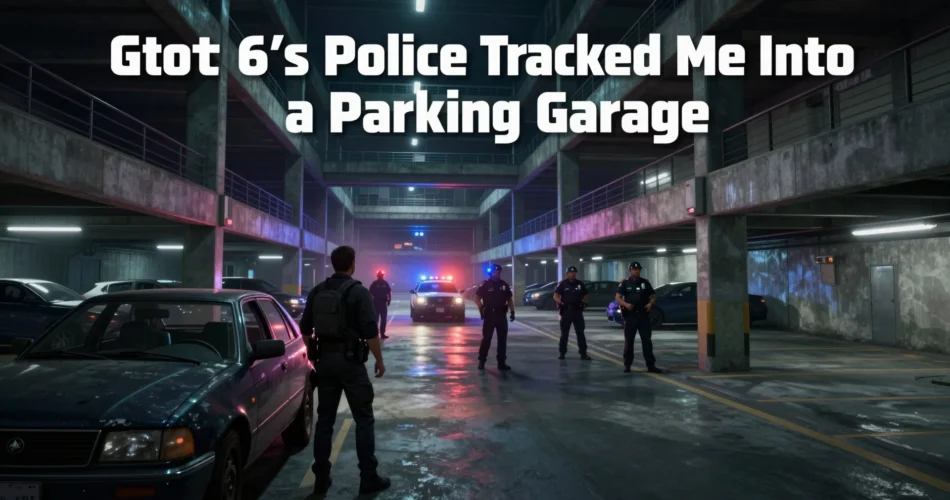
GTA 6’s Police Tracked Me Into a Parking Garage is an apt description of the sequence: after pursuing the player across roads and waterways, officers appear to search the multi-storey structure rather than simply waiting outside. That shift changes the challenge. The player is no longer only trying to drive faster; they must think about visibility, exits, alarms and where police might look next.
I’m basing this article on the supplied gameplay account, not claiming independent hands-on testing. Here’s what the chase shows about the strengths, trade-offs and practical lessons of a dynamic open-world pursuit.
How the chase began
The pursuit builds gradually. Early collisions attract attention, but nearby characters do not all react in the same way. Some seem to carry on, while people flee after a much more dramatic event: an explosion at a petrol station. The player then receives a three-star wanted level, and emergency responders, including a fire engine, arrive.
That contrast matters. A believable game world does not need every bystander to perform the same action. Some may run, some may report what they have seen, and others may not react straight away. For players, it also means the size and visibility of an incident can affect how quickly a situation escalates.
The scene suggests a useful sequence:
- An event draws attention.
- Police and other services respond to the location.
- Officers investigate before they can pursue a specific suspect.
- Further actions may reveal where the player has gone.
The delay between the explosion and direct pursuit gives the player a brief chance to move or change vehicles. But it is not a clean escape: the scene has already attracted police, and every new conspicuous action risks giving them more information.
From investigating a scene to pursuing a suspect
One of the most interesting features in the footage is the difference between investigating a crime scene and actively chasing someone. Officers initially focus on the explosion. The player manages to get into another vehicle while they appear occupied, but later actions make the player’s location more obvious and the chase begins in earnest.
That distinction makes a wanted level feel like changing attention, not a magical tracking signal. Police may know something has happened without immediately knowing who caused it or where they are now. Once the player is identified or spotted, officers can shift from responding to a scene to following, searching or blocking routes.
The response also grows in scale. Several police vehicles appear, while a helicopter provides an aerial view. Later, boats join the pursuit on the water. These different units suit different settings: a helicopter can observe open areas from above, ground vehicles can follow roads, and police boats can keep pressure on a suspect who has left land.
The footage does not prove exactly how every clue affects detection. Still, the player’s visible firearm and distinctive vehicles seem relevant to their concern about being recognised. The practical point is simple: appearance, vehicle and last known location may all matter when trying to break contact.
Inside the parking garage: a tense change of pace
The car park becomes the turning point. After reaching downtown by boat, the player enters a building and heads towards covered parking. This offers a possible break from the helicopter’s direct view, but it does not provide guaranteed safety. The player searches for a vehicle, hears police nearby and eventually finds officers moving through the building.
That makes the garage more than a hiding spot. It becomes a search area with its own risks: multiple floors, stairs, lifts, parked cars and limited exits. The player must decide whether to keep moving, try to steal a car or risk being cornered. A vehicle with an alarm might provide a fast getaway, but breaking into it creates noise and draws attention.
This is a convincing source of tension because the player’s options are useful but imperfect:
- Stay inside: gain some cover, but risk being found during a search.
- Steal a car: regain speed, but trigger an alarm or struggle to start it.
- Head for an exit: escape the building, but meet officers who may be covering it.
- Keep changing levels: avoid a direct encounter, but lose time and potential routes.
The player eventually takes a car and reaches the exit, only to find officers positioned around the garage. The scene shows how a building can interrupt pursuit without ending it. Concealment buys time; it is not the same as safety.
Pursuit AI: roadblocks, officers and coordination
The police response includes more than cars following in a straight line. During the road chase, units move alongside the player, attempt to intercept and set up roadblocks. Officers later search the garage on foot. The pursuit changes as the setting changes, which helps it feel more like a coordinated response than a single scripted chase.
A helicopter adds another layer. On open roads and near the water, its elevated view could make it harder to disappear. In the city, buildings offer more cover, but the player still has to deal with officers on the ground. The police also appear to damage the player’s vehicle, including shooting out a tyre. That turns a tactical response into a handling problem as well.
The distinction between observed and uncertain details is worth keeping clear. The footage shows roadblocks, gunfire, ground searches and aerial support. The player wonders whether spike strips are present, but does not establish that they are used. Good analysis separates what the gameplay shows from what it merely suggests.
For players, the practical lesson is that pursuit AI can apply pressure in several ways at once: reduce available routes, weaken a vehicle and search places where the suspect might be hiding. A successful escape may require changing tactics, not just accelerating.
Vehicle damage and the cost of escape
Vehicles are both tools and liabilities. The player first drives a truck with a boat trailer, then uses a large semi during the road pursuit, and later steals a car in the city. Each choice offers different advantages, but none is ideal in every situation.
The truck can push through obstacles and may feel more durable, yet its size makes it difficult to manoeuvre. By contrast, a smaller car may be easier to guide through tight streets or a car park, but it is more vulnerable to collisions. The footage also links visible damage to driving difficulty: tyres lose air, rubber flies off, and the car becomes harder to control.
| Vehicle choice | Potential advantage | Main drawback |
|---|---|---|
| Large truck | Can force through some obstacles | Slow and hard to steer |
| Small car | More nimble in streets and garages | May be fragile or alarmed |
| Boat | Offers a route away from roads | Can be slow and exposed to police boats |
Security features add another trade-off. Breaking a window may get the player into a parked car quickly, but the alarm can make a quiet escape noisy. When choosing transport, consider not just speed, but also handling, damage, visibility and the time needed to get moving.
Changing routes: streets, water and cover
The player tries several environments: roads, wooded terrain, water, a marina, city streets and a parking structure. Each creates opportunities and fresh problems. Leaving the semi for the swamp may break up the road chase, but the player is now on foot. Swimming can separate them from ground units, yet the helicopter may still watch from above—and the player encounters a shark.
Downtown offers a different kind of cover. Buildings can block a helicopter’s view and give the player indoor routes, but officers may search entrances, stairs and parking levels. That is why a route that seems safe at first can become a trap if it has only one obvious exit.
I’d think about each environment in terms of line of sight, mobility and exit options:
- Open roads give room to move but make you easier to spot.
- Woods and waterways can interrupt a car pursuit but limit transport.
- Buildings provide cover, though a search can turn them into dead ends.
- Busy streets offer choices, but collisions and alarms attract attention.
The chase demonstrates that a route is not simply “good” or “bad”. Its value depends on what follows: whether you can leave quickly, whether police can see you, and whether your current vehicle can handle the terrain.
What works—and what can go wrong
There is plenty to enjoy in this sequence, particularly if you like emergent gameplay. The police do not seem to identify the player instantly at the explosion scene, and the pursuit develops across different locations. Damage affects vehicle control, while the search inside the garage forces the player to make quick decisions.
There are drawbacks, too. A long chase can become difficult to read when several police units, alarms and escape routes overlap. The footage also leaves some mechanics uncertain: for example, it does not confirm whether changing clothes or dropping a weapon is enough to defeat a search. It is better to treat these as possible tactics, not guaranteed solutions.
Pros
- Police response appears to evolve from investigation to pursuit.
- Different environments change the escape options.
- Vehicle damage creates meaningful consequences.
- Buildings and garages add stealth and route-planning choices.
Cons
- A noisy vehicle or alarm can expose an attempted escape.
- A damaged vehicle may become hard to control.
- Losing direct sight of police does not necessarily end the search.
- Some detection mechanics remain unclear in this example.
Practical lessons for players
If you find yourself in a similar open-world chase, avoid treating speed as your only advantage. A heavy vehicle may survive impacts but struggle on tight streets. A nimble car may help in the city but fail after a few hard collisions. Before entering a building, consider whether there is more than one way out.
The footage also suggests a sensible order of priorities:
- Break direct line of sight if the current route is exposed.
- Check vehicle condition before relying on it for a long escape.
- Avoid noisy thefts when police are already close.
- Keep moving carefully through searched buildings rather than assuming they are safe.
- Look for a route that suits the terrain, not simply the shortest route.
- Treat concealment as temporary until the search has clearly eased.
Dropping a visibly carried weapon is mentioned as a possible way to appear less conspicuous, while changing clothes is considered but not shown. Neither should be presented as a guaranteed way to lose police. The broader strategy is to reduce what officers can observe while avoiding actions that immediately give away your position.
Frequently asked questions
Why did police not immediately chase the player after the explosion?
The officers first appear to investigate the explosion scene. The player’s later movements and actions seem to make their location clearer, prompting a more direct pursuit.
Did police really search inside the parking garage?
In the supplied gameplay account, officers arrive in the garage and move through it while the player tries to find a vehicle and escape. That is what makes the sequence feel more tense than simply hiding outdoors.
Can a helicopter make it harder to escape?
Yes. From above, a helicopter can monitor open areas that may be difficult for ground units to cover. Buildings and other obstacles may interrupt its view, but they do not guarantee that the player is safe.
Does vehicle damage affect the chase?
The footage shows damage affecting control. A tyre loses air, rubber breaks away, and the player finds the vehicle harder to handle. Damage is therefore more than a visual detail in this sequence.
Are spike strips used in the chase?
The player wonders whether spike strips are present, but the footage does not establish that they are used. Roadblocks and gunfire are clearly described; spike strips remain uncertain.
Does losing the police’s direct view end the wanted search?
Not necessarily. The chase suggests that officers may continue searching likely locations after direct contact is broken. Hiding can create time to move, but it is not proof that police attention has ended.
Conclusion
This chase works because it is not only about outrunning police. The player has to manage visibility, vehicle damage, changing terrain and police searches at the same time. The parking garage offers cover, but officers can enter; a stolen car restores mobility, but alarms and blocked exits create new risks.
The strongest takeaway is to stay flexible. Choose routes for their cover and exits, keep an eye on vehicle condition, and do not confuse a pause in pursuit with a guaranteed escape. In this gameplay example, every move changes the problem—and that is what makes the chase compelling.

