
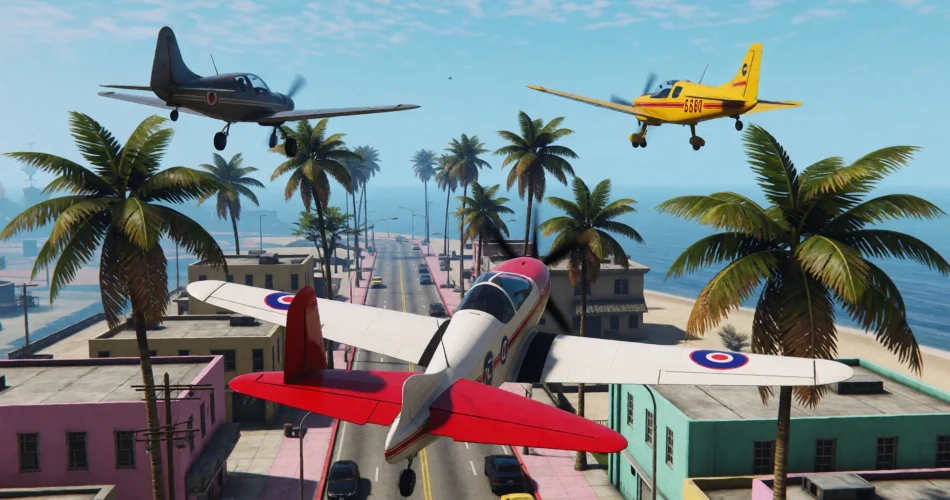
Vice City looks made for exploring from the air: coastline, islands, city streets and long stretches of open road. But choosing an aircraft is only the start. If you want to travel efficiently, land without a scrape or make a quick escape, it helps to understand the basics of flying.
This guide turns familiar flight principles into practical lessons for GTA 6 planes. One important note before we begin: Rockstar has not published final aircraft statistics or confirmed every aircraft’s availability. The aircraft and speeds listed by fan sites are estimates, not official in-game figures. I can’t claim hands-on experience with GTA 6’s flight model, so I’ll separate trailer evidence from general GTA flying advice and explain how to adapt once the game is available.
What we know about the aircraft so far
Trailer footage and the supplied aircraft guide point to several familiar types: light propeller aircraft such as the Dodo, Duster and Mammatus, as well as business jets including the Shamal, Luxor and Nimbus. A large commercial jet also appears in background footage. These sightings suggest a varied selection, but an aircraft appearing in a trailer does not guarantee that it will be available to fly.
The guide gives estimated speeds of 200–220 km/h for some prop planes and 550–600 km/h for business jets. Treat those numbers as a rough comparison, not a promise about the final game. The source itself notes that Rockstar has not confirmed aircraft statistics. The same caution applies to handling ratings.
For practice, that uncertainty is useful: focus on habits that work across different flight models. Build speed before climbing, avoid abrupt control inputs and leave room for a landing approach. I’d also keep aircraft roles in mind. A prop plane may be slower, but it could be easier to control in tight spaces; a jet may cross the map faster, but its speed can make landing and route planning less forgiving.
Choose the right aircraft for the job
The best aircraft is not necessarily the fastest one. Match your choice to what you want to do. For a long cross-map journey, a business jet such as the Shamal, Luxor or Nimbus sounds like the natural pick. For low-speed sightseeing or relaxed practice, a light aircraft such as the Dodo or Mammatus may give you more time to react. A Duster could suit low, rural routes if it appears and flies as expected.
Think of it like choosing a car in a driving game: speed matters, but so do handling and the kind of route ahead. In real life, a small training aircraft is designed for a very different job from a private jet. That same trade-off is useful when planning in a game, even if the controls and flight physics are simplified.
Before take-off, ask yourself three questions: How far am I going? Do I need to land at an airport? Am I practising, travelling or trying to evade trouble? If you’re learning, choose a forgiving aircraft and use open space. Save a fast jet for routes where you have room to climb and line up a long approach.
One caution: a list called “planes” may include aircraft that are not fixed-wing. The supplied collection includes the SuperVolito, which is a helicopter-style aircraft. Don’t apply runway lessons to a rotorcraft; its take-off and landing principles are different.
Build speed before you climb
A common beginner mistake is pulling up too early. Fixed-wing aircraft need airflow over their wings to generate lift. In game terms, that means accelerating along a runway or open road before asking the aircraft to climb. The supplied guide suggests small planes may need around 100 km/h, while jets need more, but those figures are general estimates rather than confirmed GTA 6 requirements.
Use a simple routine: line up straight, add power smoothly and keep the aircraft level while speed builds. Avoid sharp turns during the ground roll, since they can send you off the runway. When the aircraft begins to lift naturally, ease into a climb instead of yanking the controls. If it wobbles or drops back down, don’t panic; level out and regain speed where space allows.
Real-world pilots use checklists because small oversights can become serious problems. You can borrow that discipline without turning play into a chore. Before take-off, check your direction, look for obstacles and make sure you have a clear path. At a crowded airport, wait until the runway is clear rather than rushing into another aircraft’s path.
If GTA 6 offers different control or flight-assist settings, test them in a safe area. A little patience at the start is usually faster than restarting after a bad launch.
Recognise and recover from a stall
A stall happens when a wing stops producing enough lift, often because the aircraft is moving too slowly or the nose is held too high. It does not simply mean “the engine has stopped”. In games, a stall may show up as a sudden loss of altitude, sluggish controls or a nose drop. The exact warning signs will depend on GTA 6’s flight model.
The practical response is to lower the nose and let the aircraft regain speed before climbing again. Pulling harder on the controls can make the problem worse, because it increases the demand for lift while the aircraft is already struggling. If you have altitude, use it: a higher aircraft has more room to recover than one flying just above rooftops or water.
A realistic example is a sightseeing flight over the coast. You slow down to circle an island, then pull sharply upwards for a dramatic turn. If the aircraft starts sinking, resist the urge to keep hauling back. Ease the nose down, straighten the wings and build speed. Once the aircraft responds normally, climb gently.
I’d practise this only in a clear area and at a safe height. Don’t experiment over buildings, bridges or busy roads, where even a brief loss of control can end the flight. If the game includes a flight school, tutorial or challenge mode, use it to learn how the aircraft signals a stall before taking risks in free roam.
Plan your landing before you reach the runway
A rushed landing often begins long before the wheels touch down. If you approach too fast, too low or from the wrong direction, you may run out of runway or overcorrect at the last moment. Start planning early: identify the runway, line up with it from a distance and reduce power gradually. Descend in a controlled way rather than diving towards the airport.
Aim to touch down near the start of the runway, not halfway along it. Once the wheels make contact, keep the aircraft straight and apply the brakes if the game allows. Avoid sharp turns while travelling quickly on the ground. If you are too high or too fast to land safely, it is better to circle around and try again than to force a poor approach.
In real-world aviation, a stable approach matters more than a perfect-looking one. That’s a useful lesson for games too. Keep your wings level, make small corrections and avoid sudden control movements close to the ground. A jet may need more room to slow down than a light aircraft; until GTA 6’s handling is confirmed, give yourself extra space.
If airports such as Vice City International Airport are available, learn the layout during a quiet flight. Don’t assume every airstrip is suitable for every aircraft. Short runways may work for some prop planes but leave little margin for a fast jet.
Use routes and airspace to stay in control
Flying is not only about the aircraft; it’s also about where you take it. A direct line across the map may look efficient, but hills, buildings and restricted areas can make it risky. Pick a route with room to climb and turn. For a coastal journey, following the shoreline can provide clear landmarks and open space for a diversion if you need to regain control.
The supplied guide warns that GTA 5’s Fort Zancudo airspace could trigger wanted levels and SAM missile attacks. GTA 6’s military zones and rules have not been confirmed, so don’t assume they work exactly the same way. The practical lesson is to watch for signs, map boundaries or warnings and keep your distance until you know how the game handles restricted areas.
Low flying may help you stay out of sight in some games, but it also leaves less room to recover from a stall or avoid obstacles. Treat it as a deliberate risk, not a default travel strategy. In open countryside, low routes can be enjoyable; around city buildings or power lines, they demand more attention.
Plan a fallback before setting off. Know where you might turn around or land if the route becomes unsafe. Even a rough mental plan makes it easier to avoid last-second manoeuvres.
Practise with a purpose
A good way to improve is to practise one skill at a time. Start with straight take-offs, then try broad turns at a safe height. When those feel comfortable, work on approach and landing. Changing aircraft every few minutes makes it harder to learn how different speeds and handling styles affect your control.
Try setting yourself a small route between two landmarks. Fly it in a light aircraft first, then repeat it in a jet. Notice how much earlier you need to turn or slow down in the faster aircraft. This kind of comparison teaches you more than simply chasing top speed. If GTA 6 includes flight challenges or schools, use them to practise within structured limits.
For realism, think like a cautious pilot: look ahead, leave yourself space and avoid unnecessary manoeuvres near the ground. For fun, add a scenic detour or try a coastal route. There’s no need to make every flight a test.
Finally, be wary of cheat-code claims. The supplied guide lists GTA 5 spawn codes for the Stunt Plane and Duster, but says GTA 6 plane cheats have not been confirmed. Check official updates after launch rather than relying on copied codes or assumptions from earlier games.
Frequently asked questions
What is the fastest aircraft in GTA 6?
Rockstar has not confirmed official aircraft speeds. Fan-site estimates place the Nimbus and large Jet among the fastest listed aircraft, but treat these as unverified figures until the game’s final details are available.
Can I fly commercial jets in GTA 6?
A large commercial jet appears in trailer background footage, but that alone does not confirm that players can fly it. Whether it will be controllable, and how it will spawn, remains unconfirmed.
Which aircraft is best for beginners?
A light prop plane is a sensible starting point because it should be easier to practise with at lower speeds. The Mammatus and Dodo are examples in the supplied guide, though their final handling has not been confirmed.
Does GTA 6 have plane cheat codes?
No GTA 6 aircraft cheat codes have been confirmed in the supplied material. The listed Stunt Plane and Duster cheats are for GTA 5, so don’t assume they will work in the new game.
Where is the main airport in GTA 6?
Trailer and guide material refer to Vice City International Airport, or VCIA. It is presented as the main airport, but players should wait for the released game to confirm its layout and features.
Are all aircraft in the list actually planes?
No. The supplied list includes the SuperVolito, a helicopter-style aircraft. It is useful to distinguish fixed-wing planes from helicopters because they take off, turn and land differently.
Conclusion
The strongest flying habits are simple: choose an aircraft that suits the route, build speed before climbing, recover calmly from a stall and set up your landing early. Use open areas to practise, leave room for mistakes and treat published GTA 6 speed figures and cheat-code claims as unconfirmed until Rockstar verifies them. With those basics in mind, you’ll be better prepared to explore Vice City from the air—whether you’re cruising in a prop plane or crossing Leonida in a jet.

